How far along is the CAEX project?
On October 22, 2026, CAEX, part of the VPBank ecosystem, announced that it had received approval from the Cybersecurity Department for its Level 4 Information Security System proposal. With the additional capital of 10 trillion VND, CAEX is taking another step towards obtaining a cryptocurrency trading license in Vietnam.
Notably, CAEX also features the presence of two major players in the crypto industry, OKX and HashKey, providing support in areas such as technology, operational experience, and liquidity.
So, what role does each party play in CAEX, and does this combination of resources give CAEX a strong chance of being a leading contender in the Vietnamese centralized exchange (CEX) market?
1. What is CAEX?
CAEX stands for Vietnam Prosperity Digital Asset Exchange, established on September 19, 2025, with the aim of creating a platform for digital asset trading in Vietnam.
CAEX is a member of the financial ecosystem of VPBank, with VPBank Securities (VPBankS) being part of the founding shareholders. Additionally, CAEX includes LynkiD, a company that owns a platform for exchanging gift certificates and has collaborated with VPBank’s ecosystem.
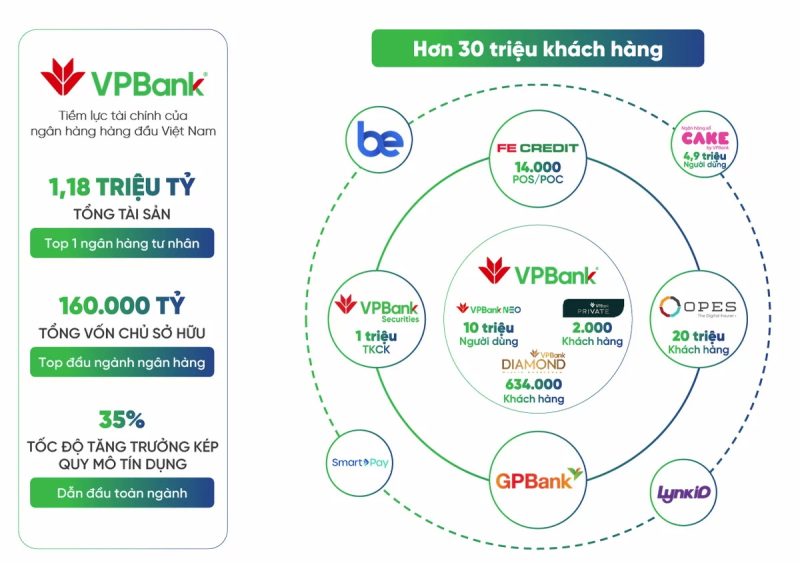
VPBank’s extensive ecosystem
Notably, CAEX has attracted the participation of international crypto organizations such as OKX Ventures and HashKey Capital as investors and strategic partners. Furthermore, OKX and HashKey are continuing to collaborate in areas such as technology, operational experience, and liquidity.
CAEX is currently part of the group of applicants still undergoing the licensing process, alongside SCEX, VIXEX, TCEX, and Moonbase. Each of these platforms utilizes a different support structure, ranging from banks and brokerage firms to large domestic corporations.
2. The development process of CAEX
In just seven months, CAEX increased its capital from 25 billion to 10,000 billion and partnered with OKX and HashKey. Subsequently, the company focused on system testing and completing the necessary licensing requirements.
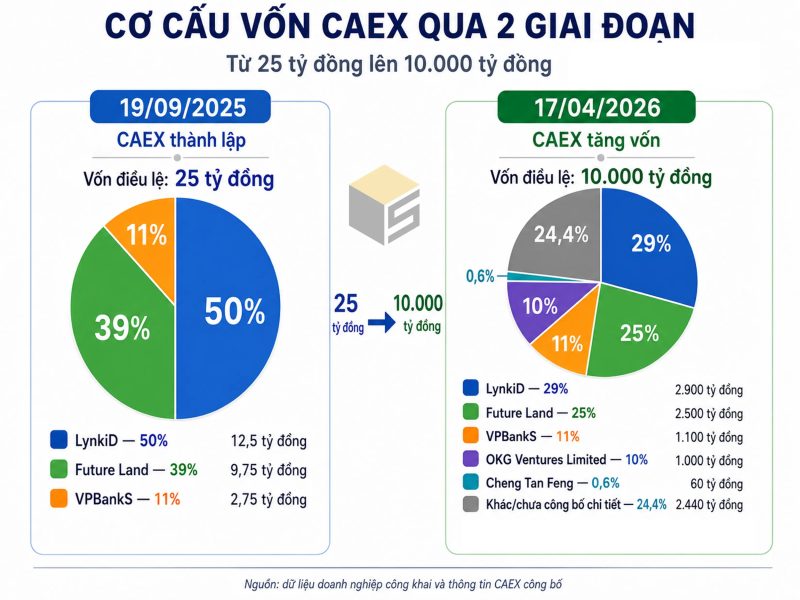
- September 19, 2025: CAEX was established with a registered capital of 2.5 billion VND, with three founding shareholders: LynkiD, Future Land, and VPBankS.
- 03/19/2026: CAEX is included in the top 5 companies with valid applications and will continue to be reviewed for licensing.
- April 2026: CAEX will increase its capital by 10 trillion won, while also partnering with OKX and HashKey for technology, operational experience, and exchange development.
- 06 – 25/09/2026: CAEX is testing a dedicated trading platform for employees and partners, which is not yet available to the general public.
- October 22, 2026: CAEX announces the completion of the security audit of the Level 4 information system by the Cybersecurity Bureau (Ministry of Public Security), but it has not yet received official approval for formal transactions.
3. Who is behind CAEX?
The current structure of CAEX can be divided into three layers: the domestic financial ecosystem around VPBank, the technology and digital services investor group, and international crypto partners such as OKX and HashKey.
3.1 VPBankS – A financial component within the VPBank ecosystem
VPBankS currently holds 11% of CAEX’s capital, amounting to approximately 1.1 trillion VND, following the company’s increase in registered capital to 10 trillion VND. VPBankS will contribute to CAEX in the areas of finance, governance, and investment expertise.
VPBankS is a securities firm within the VPBank ecosystem. By the end of 2025, VPBankS is expected to have total assets of over 73 trillion VND, pre-tax profits of approximately 4.476 trillion VND, and a total margin loan of over 34 trillion VND.
=> With CAEX, VPBank’s value extends beyond the 11% stake to include the operational experience of a large financial institution, risk management expertise, and the ability to serve investors in a well-regulated environment.
3.2 LynkiD – User files from the VPBank ecosystem
Following the capital increase in April 2026, Lynk & Co now holds approximately 29% of CAEX, amounting to 2.9 billion VND.
LynkiD has a strong relationship with VPBank, having been its exclusive loyalty partner since 2022. The company has facilitated connections between millions of users and over 1,000 brands through its point-based reward programs. Following the establishment of CAEX, VPBank continues to see LynkiD as a key partner in areas such as digital identity, user experience, and core platform infrastructure.
=> Beyond the capital, the value of LynkiD lies in its operational experience with digital platforms, user data, and the ability to connect with customers within the VPBank ecosystem.
3.3 Future Land – A major shareholder, but its role remains somewhat unclear.
Following the capital increase of 10 trillion VND, Future Land now holds approximately 25% of CAEX, amounting to 2.5 trillion VND.
Future Land is a company that began operations in late 2023, focusing on information services, an online platform, and e-commerce, as well as investments in several other industries.
However, compared to VPBank or Lynk, Future Land’s actual role in CAEX remains somewhat unclear. There has been no public announcement detailing the specific areas in which this company is involved – whether it’s in the technology, operations, or product development aspects of the platform.
=> Therefore, at the present time, Future Land should primarily be viewed as a major shareholder, with the specific strategic value to CAEX still requiring further data for assessment.
3.4 OKX – A Global Operational and Liquidity Provider
On April 10, 2026, OKX announced a strategic investment in CAEX through OKX Ventures, while also partnering with HashKey Capital as a strategic partner. Subsequently, VPBank and OKX further signed a separate agreement, with CAEX as the initial project.
OKX is one of the leading digital asset platforms globally, and has established operations with regulatory approvals in various regions, including Europe, Singapore, and Dubai. With CAEX, OKX has announced that it will provide support in areas such as operational experience, technology, risk management, compliance, and liquidity connectivity.
=> The largest benefit CAEX can expect from OKX is the opportunity to leverage a large-scale cryptocurrency exchange and its international liquidity network, allowing CAEX to avoid building these capabilities from scratch.
3.5 HashKey – Core Technology Partner
HashKey participates in CAEX through two different roles.
- On April 10, 2026, HashKey Capital was announced as CAEX’s strategic investor and partner.
- Two weeks later, HashKey Digital Asset Group signed a separate technology agreement with CAEX.
According to the agreement signed on April 22, HashKey will become a key technology partner, and will also provide HashKey CAEX with an exclusive license in Vietnam for the use of the compliant trading platform technology. HashKey will also provide support for the platform’s architecture, security, and compliance systems.
HashKey is one of the largest digital asset companies in Asia, with experience in building and operating a licensed trading platform. Therefore, the greatest value of CAEX lies in bringing a proven technology framework and compliance experience to Vietnam, rather than CAEX having to build everything from scratch.
4. How far along is the CAEX project?
Compared to its initial stages, CAEX has now completed several key components necessary to move closer to practical operation:
- Capital raised: CAEX has increased its capital from 25 billion to 10,000 billion VND, which meets the minimum requirement according to regulations.
- Technology and Operations: OKX provides operational experience, technical solutions, and liquidity connections, while HashKey offers the core trading technology.
- Safe Information System: On October 22, 2026, CAEX announced that the Cybersecurity Bureau (Ministry of Public Security) has reviewed and approved the proposed information security system level 4. This is one of the technological requirements that businesses must meet before being allowed to operate the trading platform.
- Regarding infrastructure, CAEX utilizes a private cloud-based system, incorporating both primary and backup data centers to minimize downtime in the event of an incident. The components currently being developed include an order execution system, a secure asset vault, a hot wallet, a cold wallet, and secure key management. Furthermore, the company integrates transaction monitoring, user authentication, and anti-money laundering measures into the design itself.
However, having sufficient capital and technology is only a necessary condition. When the platform is actually operational, the key factors determining the user experience will depend on the depth of liquidity, the number of market makers, the buy/sell spread, order execution speed, the ability to deposit and withdraw Vietnamese Dong (VND), asset custody mechanisms, and the stability of the system during periods of high trading volume.
5. What should investors consider?
For crypto trading siblings, the CAEX’s readiness to participate in the pilot program is a positive sign. It indicates that the licensing race is entering its final stages.
- 5phutcrypto.io has thoroughly analyzed the 2026 Vietnamese cryptocurrency law in a separate article. However, here are the key points to remember:
- Currently, no one has been penalized for transactions on Binance, OKX, or Bybit. Penalties are not expected to be imposed until six months after the first exchange receives a license, and no exchange has officially received a license as of now.
- Storing cryptocurrency in a personal wallet is not affected by the new regulations. You are still free to hold Bitcoin, Ethereum, or any other cryptocurrency in your wallet without violating any rules.
- Once the Vietnamese-based exchange goes live, all transactions will be conducted using Vietnamese Dong (VND), not USDT as is currently the case on international exchanges.
- Regarding taxes, the current legal framework stipulates that individuals transferring digital assets through licensed service providers will be subject to a 0.1% income tax on the value of each transaction. However, as of August 2026, no platform has been granted a license to operate in Vietnam, so this tax deduction mechanism has not yet been implemented in the market.
- Regarding the deadline for listing on the domestic market: According to Resolution 05, companies have 12 months from the date the Ministry of Finance announces the results of the first application round to submit any remaining documentation. Representatives of the State Securities Commission have mentioned that the deadline for completing the application process for the group involved is around May 2027.
- Regarding listed cryptocurrencies: The regulatory body encourages exchanges to prioritize popular and liquid cryptocurrencies, with Bitcoin being a suitable example. However, the specific list of cryptocurrencies available on each exchange is determined by the exchange itself, according to their regulations. CAEX has not yet announced its official list of cryptocurrencies, so it is currently impossible to confirm whether Bitcoin or any other cryptocurrency will be available for trading on the platform.(Vietnam Crypto Exchange)