
Vietnam Crypto Exchange Capital Threshold Race: From 10.1 Billion to Trillions of Dong
As the race for cryptocurrency licenses enters its decisive phase, another front is heating up: the competition for personnel who understand both traditional finance and how to operate the digital asset market.
The minimum charter capital requirement of VND 10 trillion initially led to the cryptocurrency race in Vietnam being viewed primarily from the perspective of financial strength. However, capital may not be the most difficult resource to acquire.

According to the regulations for the pilot cryptocurrency market, businesses seeking a license must not only meet capital requirements but also need a rather specialized personnel structure. The CEO must have experience in finance, securities, banking, insurance, or fund management. The Chief Technology Officer needs at least 5 years of relevant experience.
Each business must have at least 10 technology personnel holding degrees or certifications in cybersecurity and at least 10 personnel in operational departments with securities trading licenses. This is just the minimum requirement.
For an exchange to operate effectively, businesses must also build teams for legal affairs, compliance, anti-money laundering, risk management, custody, data, cybersecurity, product development, transaction operations, customer service, market creation, and user development.
CAEX, SCEX, and TCEX are simultaneously recruiting generals and troops.
Among the four cryptocurrency companies that utilize the LinkedIn job-related social network, Vietnam Prosperity Exchange Joint Stock Company (CAEX) is the name that best exemplifies the transition from building a basic framework to preparing for operation.
In the earlier stages, CAEX job openings focused heavily on roles such as Director of Compliance, Head of Risk Management, Client Identity Verification, Custody Operations, and Legal functions.
However, recently emerging positions have gradually shifted towards jobs directly related to the operations of a real-world trading platform, such as senior server-side systems development engineers, data engineers, platform operations specialists, and growth managers.
Operations personnel are required to monitor the system 24/7, handling issues related to trading orders, system interfaces, custody, cash flow, and risk management. Meanwhile, system development engineers must work with infrastructure capable of handling large transaction volumes and low latency, and participate in resolving critical incidents during actual system operation.
This shift comes as CAEX began its internal platform testing program in September 2026. CAEX appears to have passed part of the “eligibility for licensing” hurdle and is now moving on to the more difficult
question: Is the system ready to operate?
A notable advantage of CAEX lies in its expertise from the international digital asset market. Chris Chiew, Senior Advisor at CAEX, previously worked at Binance for nearly five years, overseeing business operations, spot trading, and custody. After joining CAEX, he was also directly involved in the recruitment process for management positions in compliance, institutional clients, large clients, and data analytics.
Several other CAEX personnel also have experience related to Binance, banking, fintech, and digital identity.
Sacom SCEX, a cryptocurrency exchange company, is demonstrating a different strategy: broad recruitment and maximizing the potential of its underlying securities ecosystem. SCEX’s recruitment page currently lists numerous positions.
In Hanoi, the majority of demand is focused on technology, including systems operations and software development engineers, solution architects, IT operations, server-side Java programmers, user interface and experience designers, quality testers, and ReactJS and React Native programmers.
Meanwhile, in Ho Chi Minh City, SCEX is seeking a Head of Partner Network and Referral Brokerage, a Head of Digital Asset Proprietary Trading Team, a Proprietary Trading Specialist, and content creation positions. This structure shows a clear division of roles: Hanoi focuses on building technology infrastructure, while Ho Chi Minh City concentrates on trading, liquidity, and customer distribution.
Previously, SCEX had sought additional personnel in compliance, transaction accounting, customer service, community building, and partner development. Now, some of these positions are no longer open, while proprietary trading and the distribution partner network have been expanded.
It’s impossible to confirm that all the previous positions have been filled, but this change shows that SCEX’s focus is gradually shifting from building the basic infrastructure to preparing for liquidity and user growth.
SCEX also has a distinct advantage in terms of traditional financial human resources. Chairman Nguyen Duy Khoa has experience at various organizations such as ACBS, SSI, VNDirect, Red Capital, and LPBS. CEO Nguyen Minh Huong, on the other hand, has a background combining technology, digital products, and securities, having previously worked at VNDIRECT and VNSC by Finhay.
SCEX’s recruitment system is also strongly integrated with LPBS. This helps businesses avoid having to build their financial recruitment network from scratch.
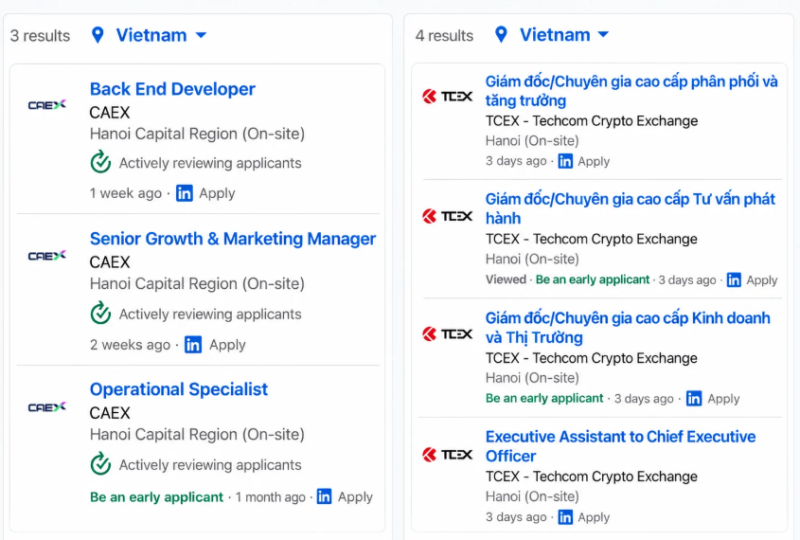
CAEX and TCEX positions are publicly advertised on LinkedIn. Photo: LinkedIn
Techcom Cryptocurrency Exchange Joint Stock Company (TCEX) seems to be choosing the approach of “recruiting the general first, then letting the general recruit the troops later.” In August 2026, TCEX appointed Mr. Ngo Duy Bien as General Director. Mr. Bien has approximately 15 years of experience in New York, having worked at Goldman Sachs, SIMON Markets, and iCapital; at iCapital, he was in charge of distributed ledger technology, blockchain, data, and artificial intelligence.
Following the appointment of the new CEO, TCEX simultaneously opened several Director or Senior Specialist positions. Among them, the position in charge of Business and Markets was tasked with developing market-making and liquidity provision programs, as well as developing institutional and large client groups.
The Distribution and Growth position must leverage the Techcombank – TCBS ecosystem to expand its user base, client assets, and transaction value. Another position focuses on advising on asset issuance and tokenization, suggesting TCEX’s ambitions may extend beyond a simple cryptocurrency exchange.
A common feature of these positions is the requirement for very high seniority, and, at the Director level, the successful candidate must also continue to build a team below them.
Meanwhile, at VIX Crypto Asset Exchange Joint Stock Company (VIXEX), there hasn’t been a new recruitment wave comparable to its three competitors. However, VIXEX previously recruited compliance specialists with experience using blockchain analytics, transaction monitoring, and detecting money laundering-related activities. The current silence may stem from VIXEX having partially met its needs, either by using headhunters or leveraging resources from the VIX ecosystem.
How much could the personnel costs amount to?
The talent race among cryptocurrency exchanges can be divided into four main areas.
The first area is legal, compliance, and risk management, serving licensing requirements. The second area is technology, cybersecurity, data, custody, and product, responsible for building the platform. The third area includes exchange operations, fraud prevention, customer identity verification, and customer service, ensuring the system can operate continuously.
The final aspect involves market making, institutional clients, large clients, proprietary trading, partner networks, and user growth. This group determines whether an exchange will have liquidity and customers after being licensed.
CAEX, SCEX, and TCEX have all begun to see demand at the final tier. At least these businesses are no longer just hiring to complete licensing paperwork, but have begun preparing for future exchange operations. This is also where the cost issue becomes significant.
According to Adecco’s Salary Guide 2026, in Hanoi, a Chief Technology Officer or Chief Information Officer with more than 5 years of experience can expect a pre-tax salary of approximately 180-350 million VND per month. Solution architects earn around 80-160 million VND. Network security managers earn 60-120 million VND. Operations and systems development engineers earn 45-90 million VND. Data engineers earn 50-100 million VND. Software engineers earn 40-80 million VND.
These are all positions currently appearing in the recruitment plans of these platforms.