
Vietnam’s crypto exchange pilot postponed, new regulations implemented ahead of schedule
The Vietnamese government has officially missed its initial target to launch a domestic crypto asset trading pilot in the third quarter of 2026. Although Deputy Finance Minister Nguyen Duc Chi stated earlier this year that he hoped to have the market operating under regulatory supervision within Q3, the State Securities Commission (SSC) had yet to issue a single operating license as of early November 2026.
Meanwhile, supporting regulatory rules have arrived right on schedule. On October 31, 2026, Vietnam’s Ministry of Finance officially signed Circular No. 165/2026/TT-BTC governing reporting and information disclosure for the crypto asset pilot market, which will take effect on December 18 of the same year. This means that before a single institution has received legal authorization to trade, the strict compliance reporting clock has already started ticking 43 days in advance.
Currently, Vietnam’s crypto trading pilot presents a clear landscape characterized by “complete regulations, tiered divergence, and dual-track timelines.”
I. Meeting Both “Security Certification & Paid-in Capital”: The Latest Competitive Landscape of the 5 Shortlisted Candidates
Since the Vietnamese government promulgated Resolution No. 05/2025/NQ-CP in September 2025 to initiate a five-year pilot for the crypto asset market, the competitive landscape among the first batch of five candidate institutions has undergone a decisive divergence in recent weeks.
On the technical security front, between October 22 and 26, three candidates—CAEX, SCEX, and TCEX—successively passed the Level 4 information system security assessment conducted by the Department of Cybersecurity and High-Tech Crime Prevention under the Ministry of Public Security. On the capital threshold front, Resolution No. 05 strictly requires applicants to hold 10 trillion VND (approximately $400 million USD) in paid-in charter capital.
Currently, CAEX, SCEX, and TCEX have all met the 10 trillion VND paid-in capital threshold, forming the first tier of contenders holding both “Level 4 security certification” and “fully paid-in capital,” while the remaining two candidates still face substantial funding gaps:
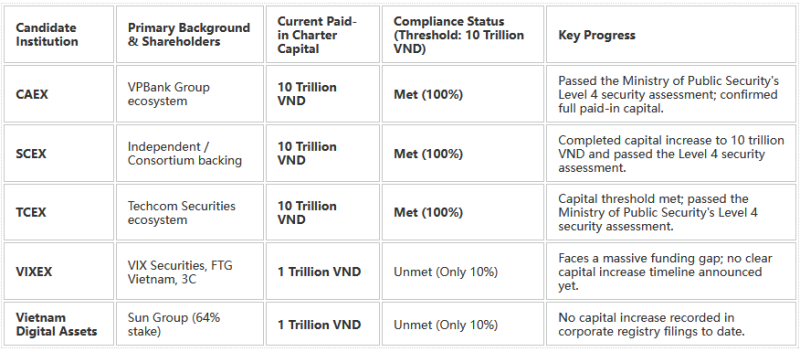
- For the institutions that have yet to meet the capital requirement, raising funds on the scale of trillions of Vietnamese dong involves complex procedures, including shareholder resolutions, regulatory approvals, and actual cash transfers into corporate bank accounts. Consequently, their progress no longer depends on the SSC’s review pace, but is entirely constrained by their own balance sheets.
II. Bank-Grade Risk Control: The Stringent Compliance Requirements of Circular 165
Issued on October 31, Circular 165 is not built around agile trial-and-error for tech startups; rather, it directly transplants the back-office risk control and clearing standards of traditional banking. The circular imposes high-frequency reporting and disclosure obligations on future licensed exchanges:
- Daily Trading Reports: Complete trading data from the previous session must be submitted to the SSC before 15:00 every business day.
- Weekly Custody Reconciliation: Client fund custody balances must be reconciled with partner banks and reported every Monday.
- Real-Time Market Transparency: During trading hours, websites must display real-time top-three bid and ask order book depths alongside foreign capital flows. All disclosures must be bilingual (Vietnamese and English), with the Vietnamese text prevailing.
- Semi-Annual Asset Statements: Comprehensive asset statements must be issued to clients every six months.
- 24-Hour Incident Response: Any technical system failure or security incident must be reported to regulators within 24 hours.
- 10-Year Data Retention: All trading, custody, and compliance records must be preserved intact for at least 10 years.
Over the past year and more, Vietnamese regulators have efficiently built a complete institutional loop: Resolution No. 05 established the pilot framework in September 2025; Decision No. 96 defined the five-step licensing process in January 2026; accounting and tax guidelines followed in March and April; Decree No. 284 subsequently added penalties for unlicensed operations, price manipulation, and late reporting; and finally, Circular 165 completed the reporting rules at the end of October. As regulators have pointed out, while Hong Kong and Indonesia took four to five years to establish comparable frameworks, Vietnam completed its rule-making in just 14 months.
III. Running on Two Calendars: End of 2026 or May 2027?
With the Q3 target pushed back, Vietnam’s crypto exchange pilot is effectively operating on two separate schedules:
- Compliance Effective Date (December 18, 2026): Regardless of whether any exchange has obtained a license by then, Circular 165 will take effect as scheduled. Currently, a joint review panel comprising the Ministry of Finance, the Ministry of Public Security, and the State Bank of Vietnam is conducting final pre-licensing reviews. If the first batch of licenses is approved before the end of 2026, exchanges will face a live stress test of the daily 15:00 reporting rule on the very morning of their debut.
- Administrative Review Deadline (May 2027): According to the SSC’s internal working schedule, the final approval deadline is May 2027—exactly 12 months after the initial five applications cleared preliminary review in May 2026. If no licenses are issued before December of this year, Circular 165 will remain temporarily on standby, postponing the final outcome of the pilot until the first half of 2027.
As things stand, passing the Ministry of Public Security’s Level 4 security certification, securing 10 trillion VND in paid-in capital, and possessing the back-office capability to reconcile “trading ledgers, bank custody balances, and public market feeds” every morning before market open have already filtered the market ahead of time. The institutions truly standing at the starting line right now are the three “fully compliant” contenders: CAEX, SCEX, and TCEX.(Vietnam crypto exchange)