Binance’s $6.3B Incident & CAEX/TCEX Security Challenges
The Binance exchange hack, which resulted in an estimated loss of $6.3 billion in assets, has raised significant concerns about cybersecurity on a global scale.
Binance, the world’s largest cryptocurrency exchange, announced a cyberattack that affected approximately $6.3 billion in assets. This is considered the largest cybersecurity incident in the history of the cryptocurrency industry. The exchange stated that approximately $3 billion has been frozen on the blockchain, and deposit and withdrawal operations have been temporarily suspended. Binance also pledged to bear all losses and affirmed that user assets remain safe.
Commenting on the event, expert James Seyffart from Bloomberg Intelligence stated that the draining of hot wallets is not a new story, but with such a massive amount of money involved, this is a large-scale attack targeting the market’s largest trading platform. The incident will undoubtedly have a negative impact on the image of the entire industry, given the series of security incidents that have occurred.
In the Vietnamese market, the impact of the incident extends beyond international trading platforms and directly affects investor sentiment. Jack Nguyen, CEO of Blockbase investment fund, analyzed that Binance’s temporary suspension of deposits and withdrawals will cause those wishing to withdraw capital to shift to the over-the-counter (OTC) market. As panic spreads and triggers simultaneous sell-offs, the imbalance between supply and demand could cause stablecoins like USDT to fluctuate sharply or plummet in the OTC market. However, this expert assessed that the $6.3 billion loss is not too large compared to Binance’s asset size, and the exchange’s commitment to compensating for losses is credible based on its current financial capacity.
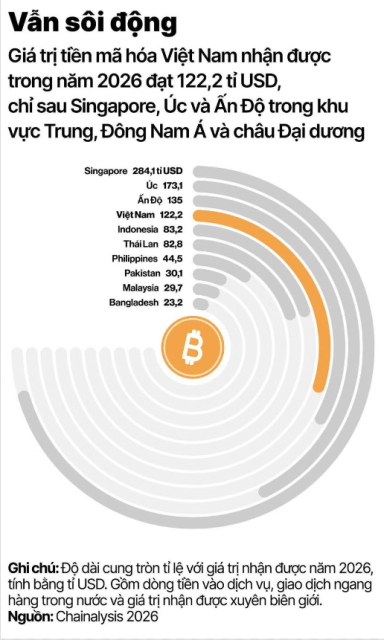
The attack occurred at a time when cryptocurrency flows in Vietnam were at a very high level. Data from Chainalysis, updated to September 2026, shows that between July 1, 2025, and June 30, 2026, the Vietnamese market recorded $122.2 billion in cryptocurrency transactions. This figure places Vietnam fourth among the top 10 countries in Central Asia, Southeast Asia, and Oceania, accounting for 12.1% of the region’s total value of $1.008 trillion. Within Southeast Asia alone, Vietnam ranks second only to Singapore and contributes nearly 19% of the total transaction value of the six ASEAN economies included in the report.Tìm hiểu lịch sử
Pilot legal framework for CAEX, TCEX and the challenges of building trust.
The scale of the cryptocurrency market, involving hundreds of billions of USD, necessitates the urgent development of a secure and regulated trading market. Vietnam is currently making steady progress towards establishing a licensed cryptocurrency trading market. On October 22nd, Vietnam Prosperity Cryptocurrency Exchange Joint Stock Company (CAEX), a member of the VPBank ecosystem, announced the results of its Level 4 information system security assessment. The very next day, Techcombank’s Techcom Cryptocurrency Exchange Joint Stock Company (TCEX) also announced that its Level 4 information system security proposal had been assessed and approved by the Cybersecurity Department of the Ministry of Public Security .
This is one of the key technological requirements for entities participating in the cryptocurrency market pilot program under Resolution 05/2025/NQ-CP. Mr. Phan Duc Trung, Chairman of the Vietnam Blockchain and Digital Asset Association, stated that the Level 4 security requirement, along with the process of custody and management of customer assets, are very high standards, even exceeding the requirements for current securities companies.
However, drawing lessons from Binance, Mr. Trung emphasized that achieving Level 4 information system security standards is only a necessary condition. Pilot exchanges and state regulatory agencies need to consider adding standards at the operational level. These standards could include limiting the percentage of assets held in hot wallets, implementing multi-party signing architecture, monitoring blockchain transactions in real time for authorized operations such as EIP 7702, establishing a mechanism to automatically stop deposits into wallets showing signs of being compromised, and building a user protection fund of appropriate scale.
Sharing this view, Jack Nguyen believes that the Binance incident will not change the licensing process in Vietnam, but will make security preparations for domestic exchanges more important than ever. When the market officially goes live, the ability to protect customer assets will be a decisive factor in investors’ trust in the new system. For a financial market, attracting capital is difficult, but maintaining the trust of participants to ensure sustainable development is an even greater challenge.(Vietnam Crypto Exchange)