
Vietnam drops 14 places in crypto adoption ranking
Vietnam has dropped to 18th place in Chainalysis’s 2026 Global Crypto Adoption Index after years of consistently being among the world’s leading countries.
Vietnam unexpectedly drops in the rankings.
According to the latest report fromChainalysisBrazil has risen to the top of the world in terms of cryptocurrency adoption in 2026, followed by the US and Nigeria.
The Asia-Pacific region continues to be one of the most dynamic, contributing 9 of the top 20 countries globally, including Japan, South Korea, India, Thailand, China, Indonesia, Australia, Vietnam, and the Philippines.
In this group, Vietnam ranks 18th in the world , a drop of 14 places compared to4th place in 2025and left the leading group that the market had maintained for many years. However, the two rankings are not entirely comparable, as Chainalysis has significantly changed its index construction methodology this year.
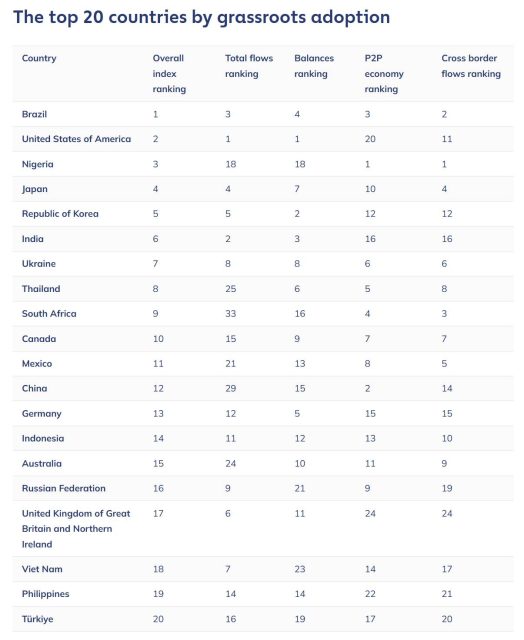
Global Crypto Asset Adoption Index 2026. Source: Chainalysis
In 2025, Chainalysis’ ranking was based on four institutionally-heavy components : inflows into centralized platforms, retail inflows into centralized platforms, DeFi, and institutional inflows into centralized platforms. In 2026, the criteria were revised to be more focused on the grassroots – using criteria including inflows into crypto services, direct transactions between domestic individual wallets, cross-border inflows, and the amount of assets held on the blockchain.
After adjusting for purchasing power and standardizing the data, Chainalysis takes the geometric mean of all four components to determine the final ranking. This method prioritizes countries with a balanced level of adoption, rather than allowing superior performance in one criterion to mask weaknesses in others.
According to the new calculation, Vietnam ranks 7th globally in terms of inflows into crypto services, but only 14th in domestic P2P transactions, 17th in cross-border flows, and 23rd in on-chain asset holdings. Conversely, Brazil does not lead in any individual criterion but ranks 3rd, 4th, 3rd, and 2nd respectively in the four components, thus leading the overall ranking.
This year’s results were recorded amidst one of the sharpest downturns in market history. From July 2025 to June 2026, the global crypto market capitalization at one point fell by 50%, equivalent to a loss of approximately $2.1 trillion, while Bitcoin lost $67,000 from its peak to its trough.
Nevertheless, the size of the global crypto economy only decreased by 1.6%, from $9.5 trillion to $9.4 trillion. For comparison, the 2023 downturn saw crypto activity shrink by 23%, even though the total market capitalization only decreased by about $300 billion. Chainalysis suggests that P2P trading, payments, and stablecoins have helped the market better withstand the sharp decline in asset prices.
Vietnam still recorded $122.2 billion in crypto activity.
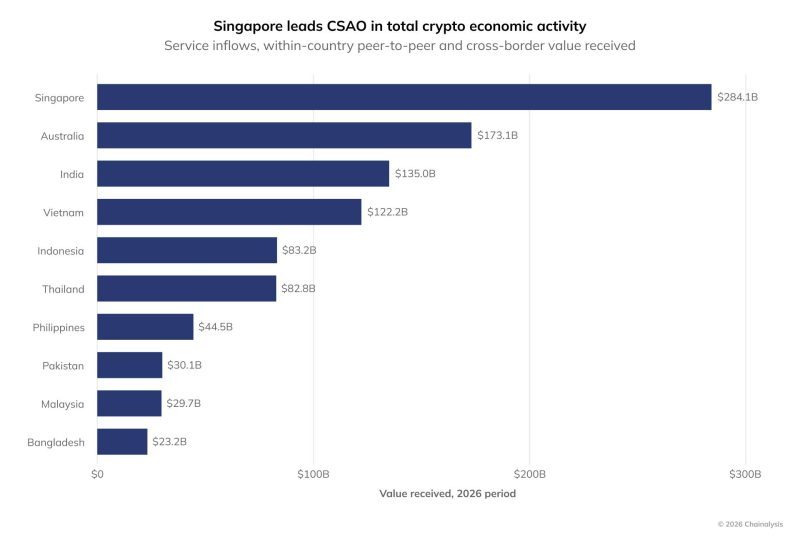
Meanwhile, according to the report.”The 2026 Geography of Crypto Report”According to Chainalysis’s report on September 30th, the value of cryptocurrency activity in Vietnam is projected to reach approximately US$122.2 billion between July 2025 and June 2026, ranking fourth in the Central and Southeast Asia – Oceania (CSAO) region, after Singapore (US$284.1 billion), Australia (US$173.1 billion), and India (US$135 billion).
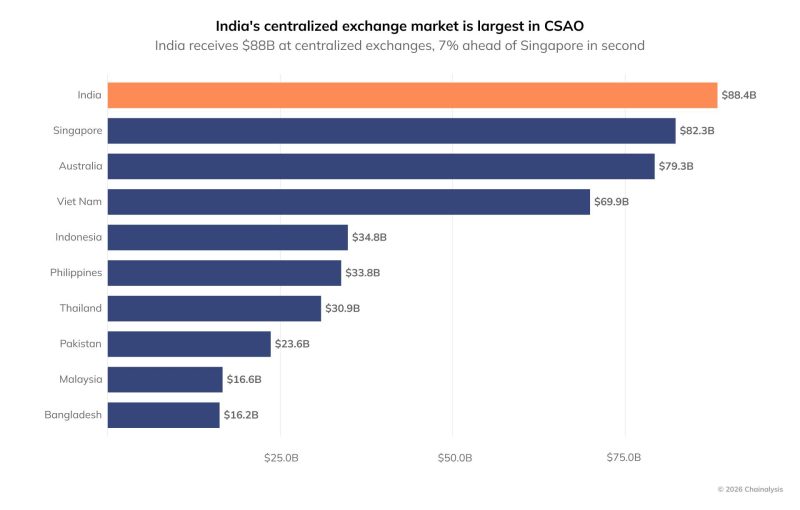
Specifically, cash flow through centralized exchanges (CEXs) reached nearly $70 billion , equivalent to 57% of the total recorded activity. Vietnam thus became the fourth largest CEX market in the region, after India ($88.4 billion), Singapore ($82.3 billion), and Australia ($79.3 billion).
The way Vietnamese people use crypto has also changed. The index reflecting practical application activities in Vietnam increased by 127% compared to the previous period, while the financial activities group decreased by about 5%. The main driving force came from direct transactions between users and cross-border money transfers, instead of trading, lending, or platforms serving institutional capital flows.
This trend is occurring against the backdrop of a surge in P2P transactions globally. During the reporting period, inflows into exchanges, DeFi protocols, and crypto services decreased by 4.3% to $8.9 trillion, but the value of direct transfers between individual wallets within the same country increased by more than 300%, from $56.8 billion to $228.7 billion.
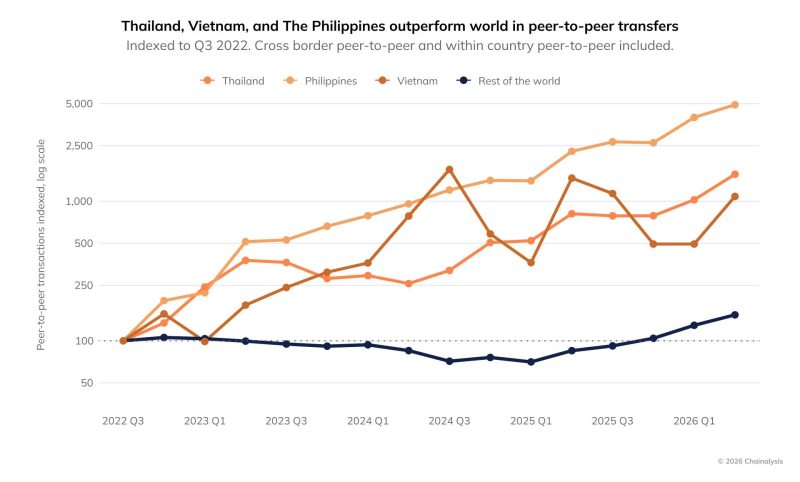
Vietnam, Thailand, and the Philippines are the most prominent P2P markets in the region. These three countries recorded a combined 5.4 million P2P transactions under $10,000, accounting for 14.4% of global transactions of this type, despite representing only about 2.5% of the world’s crypto economy. Over 80% of domestic P2P transactions in these three markets are valued under $1,000, with an average transaction size of just $618, nearly half the $1,210 average in the rest of the world.
Stablecoins dominate cross-border money flows.
Stablecoins are a key link in this trend. Globally, stablecoins now account for approximately 96% of P2P value, while the value of stablecoins traded across borders increased by 77.5% to $220.3 billion. Monthly value has more than doubled, from approximately $11 billion in January 2025 to $24 billion in June 2026.
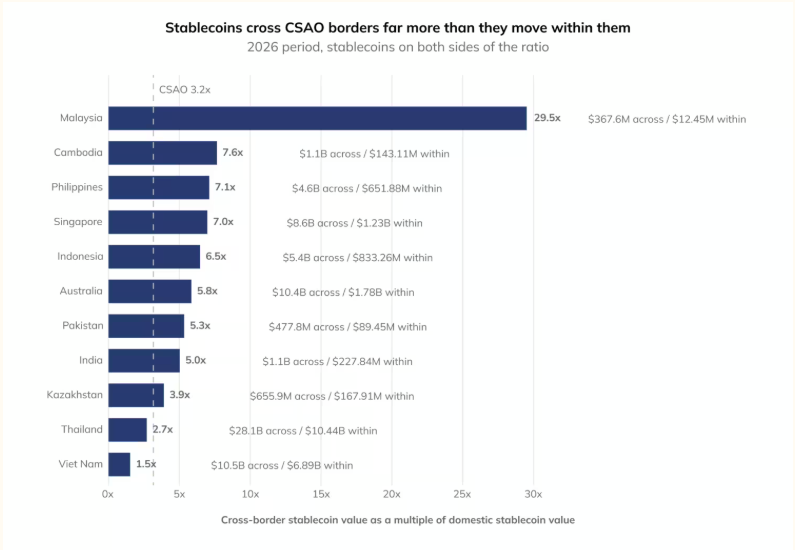
The average size of a cross-border stablecoin transaction is around $3,000, significantly lower than institutional transactions. Chainalysis suggests this data aligns with real-world needs such as paying suppliers, sending money home, or shifting savings away from depreciating currencies.
In Vietnam, domestic stablecoin activity reached approximately $6.9 billion, while cross-border flows amounted to $10.5 billion, about 50% higher. This is also a general trend in the region, as all markets surveyed by Chainalysis recorded cross-border stablecoin transactions exceeding domestic transactions; the average difference across CSAO is about 3.2 times.
According to Chainalysis, in countries with already fast and relatively efficient domestic payment systems, the need for stablecoins for domestic payments may be lower. The advantages of stablecoins are more apparent in cross-border payments, where businesses and individuals can take advantage of faster payment speeds and lower costs compared to some traditional channels.
The shift in Vietnam also differs from that of more developed financial centers in the region. While Vietnam, Thailand, and the Philippines excel in P2P and digital applications, Singapore and Australia are accelerating in the institutional sector. Institutional platforms within the CSAO processed $152.3 billion, a 40% increase year-over-year, and accounted for 18.9% of total regional activity by the end of Q2 2026.
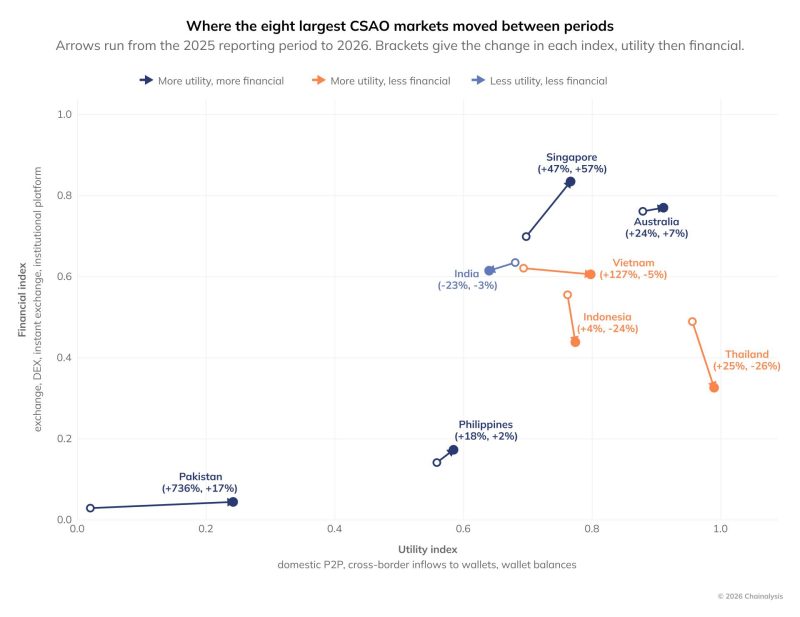
Singapore is the clearest example, with its crypto economy reaching $284 billion, a 55.4% increase. Inflows through institutional platforms surged by 94% to $60 billion, while CEXs rose 30% and DEXs increased 69%.(Vietnam Crypto Exchange)