
Vietnam Imposes 0.1% Tax on Digital Asset Transfers to Ensure Fairness Across Investment Channels
For a long time, Vietnam has consistently ranked among the countries with the highest cryptocurrency adoption rates globally. However, massive retail trading volumes operating within a longstanding legal “gray area” have not only exposed local investors to elevated risks of fraud and fund insecurity, but also led to the erosion of the national tax base and a tax burden imbalance between traditional financial markets and the digital asset sector.
With the intensive rollout of a series of core legislation and supporting regulations, the Vietnamese government has officially brought an end to this era of unregulated growth, establishing a clear and rigorous compliance and taxation framework for the digital asset market. Among these measures, imposing a 0.1% tax on the transaction value of crypto-asset transfers serves as a pivotal step toward achieving both regulatory compliance and cross-channel tax fairness.

I. From Legal Recognition to Pilot Launch: The Institutional Evolution of Vietnam’s Crypto Regulation
Vietnam’s digital asset tax regime was not introduced in isolation; rather, it is built upon a progressive, multi-tiered framework of top-level legislation and pilot programs developed over the past year:
- Top-Level Legislation Establishes Asset Status: In June 2025, Vietnam’s National Assembly passed the Law on Digital Technology Industry (Law No. 71/2025/QH15, which took effect on January 1, 2026). For the first time, the law formally recognized the legal status of digital assets and crypto-assets, defining them as an independent, legally protected asset class while clearly distinguishing them from fiat currency and traditional securities.
- Launch of a Five-Year Market Pilot Program: On September 9, 2025, the Vietnamese government promulgated Resolution No. 05/2025/NQ-CP, officially launching a five-year pilot program for the crypto-asset market (slated to run until September 2030). The resolution establishes a strict licensing regime, mandates that all issuance, trading, and payment settlements be conducted in Vietnamese Dong (VND), and sets high entry barriers for licensed Crypto-Asset Service Providers (CASPs)—including a minimum paid-in charter capital of VND 10 trillion, a 49% cap on foreign ownership, and compliance with Level 4 information security standards.
- Tax Guidelines and Collection Rules Take Effect: To support the operation of the pilot program, Vietnam’s Ministry of Finance issued Circular No. 32/2026/TT-BTC (effective March 27, 2026) and Circular No. 41/2026/TT-BTC (effective April 6, 2026), systematically clarifying the tax rates, collection standards, and withholding obligations for crypto-asset transactions regarding Value-Added Tax (VAT), Personal Income Tax (PIT), and Corporate Income Tax (CIT).
II. Core Mechanisms of the 0.1% Transaction Tax and Differentiated Tax Design
Pursuant to Ministry of Finance Circular No. 32/2026/TT-BTC and the amended Law on Personal Income Tax of 2025, Vietnam has designed a differentiated tax structure for crypto-asset transactions that balances administrative efficiency with the varying profiles of market participants:
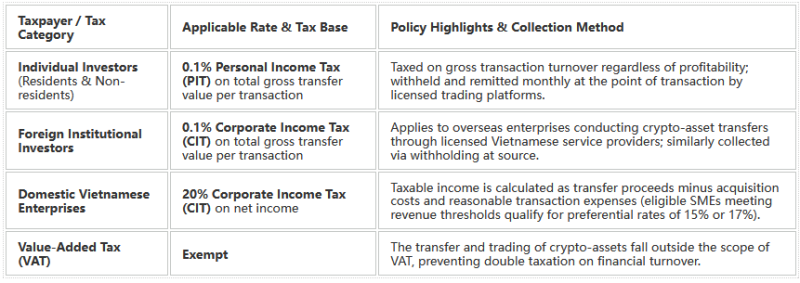
III. Why 0.1%? Benchmarking Against the Securities Market to Ensure Cross-Channel Investment Fairness
The Vietnamese government’s decision to adopt a “0.1% tax on transaction value” model is driven by a core policy objective: eliminating tax arbitrage across different investment channels and upholding fairness in the financial market.(Vietnam crypto exchange)
- Full Alignment with Vietnam’s Stock Market Tax Regime: Under Vietnam’s existing tax laws, individual investors buying and selling stocks on securities exchanges are likewise subject to a 0.1% personal income tax on the total gross value of each sell transaction, while remaining exempt from VAT. Previously, the untaxed status of crypto-asset trading prompted speculative capital to flow out of the strictly regulated stock market and into underground crypto channels for tax avoidance. Setting the crypto-asset transfer tax rate at precisely 0.1% places digital assets and traditional securities on an equal footing in terms of transaction tax burdens, preventing tax disparities from distorting capital allocation.
- Reducing Tax Compliance and Administrative Friction: Given the extreme price volatility of crypto-assets and the prevalence of cross-chain and high-frequency trading, adopting a traditional “capital gains tax” (requiring transaction-by-transaction calculation of purchase costs and realized profits) would impose prohibitive accounting burdens on both retail investors and tax authorities, easily leading to underreporting and disputes. By mirroring the securities market’s “micro-tax” model of 0.1% on gross transaction value, automated tax withholding can be seamlessly executed through licensed trading platforms—securing state fiscal revenue while minimizing compliance friction.
- Pairing with Penalties to Channel Funds into Licensed Platforms: The low 0.1% tax rate is not merely aimed at revenue collection, but at bringing market activity under regulatory oversight. Under accompanying administrative penalty regulations (effective September 1, 2026), six months after the first crypto-asset service provider is licensed, domestic Vietnamese investors who continue trading via unlicensed offshore platforms or over-the-counter (OTC) channels will face administrative fines ranging from VND 50 million to VND 100 million, with severe violations potentially incurring criminal liability. A modest 0.1% tax rate paired with clear legal protections offers the country’s vast base of local investors a cost-effective, legitimate pathway to trade in the open.
IV. Conclusion
From granting legal recognition under the Law on Digital Technology Industry and establishing a high-threshold licensing framework via Resolution No. 05/2025/NQ-CP, to codifying the 0.1% transaction tax in Circular No. 32/2026/TT-BTC, Vietnam is deploying a coordinated policy package to reshape its digital asset landscape. Levying a 0.1% tax on digital asset transfers not only addresses demands for tax parity from traditional securities investors, but also marks a decisive turning point as one of Southeast Asia’s most dynamic crypto markets leaves behind its era of unchecked expansion and enters a new cycle of legalized, standardized, and transparent growth.