
Vietnam opens crypto pilot to foreign investors, but permitted token types remain unclear
Vietnam has set up its crypto-asset pilot so Vietnamese companies can issue eligible asset-backed tokens, but only to foreign investors. Domestic investors cannot subscribe to the new offerings.
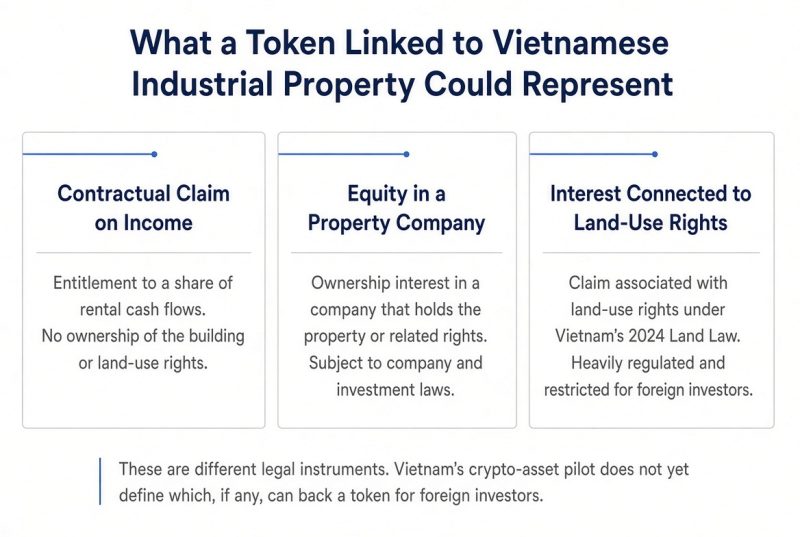
That design raises a practical question for international capital. If a token is tied to Vietnamese industrial real estate, what does the holder actually own? A claim on rental income, an equity stake in a property company, or rights connected to the underlying land-use arrangement are not interchangeable. Vietnam’s framework is opening space for new financial products. It has not yet defined which of those products can lawfully give foreign investors exposure to real property.
A crypto market with two different investor groups
Under Resolution 05/2025/NQ-CP, newly issued asset-backed crypto assets must be backed by real underlying assets, excluding securities and fiat. They can be offered and traded among foreign investors through licensed service providers. Offering, issuance, trading, and payment must all take place in Vietnamese dong. Existing domestic crypto holders can use licensed providers under separate rules. That access does not make them eligible for the new asset-backed issuances.
Vietnam’s large existing crypto user base and the investors the pilot is designed for are therefore separate markets. Substantial crypto activity does not demonstrate demand for tokenized Vietnamese property.
Why institutions sit at the center
Service providers under the pilot must meet a VND 10 trillion charter-capital threshold. Institutional shareholders must contribute at least 65 percent of that capital, and aggregate foreign ownership cannot exceed 49 percent. Additional requirements cover cybersecurity, personnel, governance, and operations. Several organizations have cleared initial application reviews. Those reviews are not the same as operating licenses. Approval of a service provider also does not establish that any particular property-linked instrument is eligible for issuance or trading.
What a foreign investor would actually own
Under Vietnam’s 2024 Land Law, land is held under an all-people ownership system, with the state acting as representative owner. Investors may hold land-use rights, own assets attached to land, or participate in enterprises that hold property-related rights, subject to applicable investment and land rules. Foreign-invested enterprises can access land through specific arrangements, including certain industrial-park structures, but the rights depend on the investment vehicle.
A token linked to a warehouse near Ho Chi Minh City could therefore represent one of three different things:
- A contractual entitlement to a share of rental income
- An equity interest in a property-owning company
- A claim associated with land-use rights
These are different legal positions. Resolution 05 also excludes securities from the underlying assets that may back newly issued crypto assets under the pilot. That exclusion is neither a blanket ban on all property-linked instruments nor permission to tokenize shares, fund interests, or land-use rights. Classification depends on the rights the instrument actually conveys.
The reform roadmap
Decision 1413/QD-TTg, issued in July 2026, sets a financial-market reform program running toward 2045. It calls for reviewing overlapping provisions across securities, real estate business, housing, land, civil, and foreign-exchange laws. The decision identifies real-world asset tokenization, project cash-flow-backed bonds, and real estate investment funds among the products future reforms could facilitate, beginning with regulatory sandboxes. It is a roadmap, not current authorization for tokenized real estate products.
Three developments matter for foreign institutions:
- Which asset-backed instruments regulators will permit, and under which legal frameworks
- How foreign ownership limits, land-use restrictions, currency rules, and instrument-specific rights will interact
- Whether licensed providers and permitted products will support institutional requirements for due diligence, servicing, and reporting
Vietnam is distinguishing between domestic crypto activity, new asset-backed issuance reserved for foreigners, and the institutions authorized to operate the market. Its industrial and logistics sector has identifiable investment drivers. The financial reform agenda acknowledges that new instruments connecting real assets to capital may require changes in multiple areas of law. For a foreign investor, the token is only part of the investment. The rights it represents, the quality of the underlying asset, and the rules governing participation determine what can actually be acquired. That is the development to watch.(Vietnam Crypto Exchange)
This publication is for informational and educational purposes only and does not constitute investment, financial, legal or tax advice, or an offer or solicitation to invest. Information is based on publicly available sources believed to be reliable at the time of publication and may change without notice. Readers should conduct their own research and seek appropriate professional advice where necessary.