Why Vietnamese Crypto Exchanges Face Stringent Level 4 Security Requirements
Under Vietnam’s latest cybersecurity framework, cryptocurrency exchanges face an exceptionally strict regulatory threshold: they must achieve Level 4 Information Security. This standard not only exceeds that of traditional stock exchanges (Level 3), but also aligns with the core systems of major banks serving over 10 million users. So, why are Vietnamese regulators imposing such stringent security requirements on crypto exchanges?
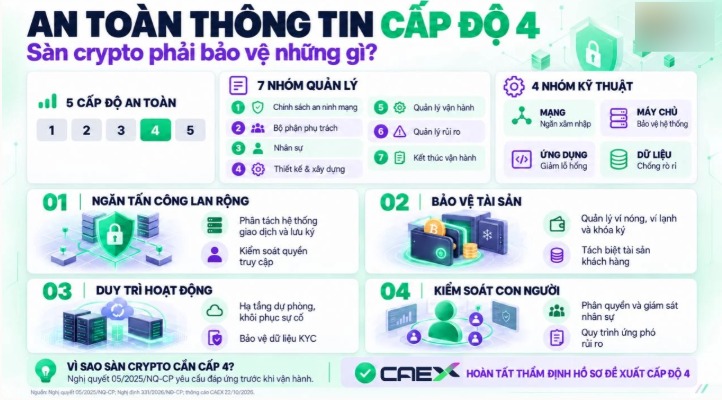
The requirement for Vietnamese crypto exchanges to attain Level 4 security is primarily driven by the following key factors:
1. High-Stakes Impact: Safeguarding Financial and Social Stability
In Vietnam’s 5-level cybersecurity classification system, Level 4 is reserved for systems where a breach or failure would cause exceptionally severe damage to public interest and social order, or major harm to national security. By comparison, local stock exchanges are currently required to meet Level 3, whereas Level 4 is typically reserved for core systems at major banks processing data for over 10 million customers.
2. Unique Industry Risks: Direct Custody of Massive Financial Assets
Unlike standard digital platforms, crypto exchanges do not merely match trades—they also directly hold crypto assets in custody and manage user deposit/withdrawal wallets. Any security failure translates directly into the immediate loss of users’ real-world wealth.
3. Mitigating Systemic Risks and Data Breaches
Preventing Lateral Spread: Exchanges comprise multiple interconnected modules (trade matching, accounts, custody). Level 4 standards mandate strict network segmentation and access controls to ensure that even if one module is compromised, attackers cannot easily pivot to core asset storage.
Ensuring Business Continuity: Systems must incorporate high availability, disaster recovery, and rapid restoration capabilities to prevent downtime that could freeze trading or withdrawals.
Protecting Sensitive User Data: KYC (Know Your Customer) information—such as IDs and personal details—must be rigorously safeguarded to prevent identity theft and fraud.
4. Controlling Internal and Operational Risks
Even the best technology can fail due to human error or excessive access permissions. Level 4 standards establish strict guidelines for personnel management, granular permission controls, and operational workflows to minimize internal security risks.
Ultimately, achieving Level 4 information security is not just a regulatory checkbox; it is necessitated by the custodial nature and inherent high risks of the crypto industry. Only by building robust security defenses can exchanges protect user assets and privacy, fostering a safe, healthy, and sustainable crypto market in Vietnam.