What are the differences between TCEX and MIMO?
Although both TCEX (Techcombank Crypto Exchange) and MIMO (a stablecoin intermediary solution developed by Dragon Lab) are part of Vietnam’s historical process of crypto asset compliance and fiat gateway enablement, they differ fundamentally in positioning, architecture, background, and business models.
TCEX is a cryptocurrency exchange established pursuant to Decision No. 96/QD-BTC of the Ministry of Finance.(Vietnam crypto exchange)
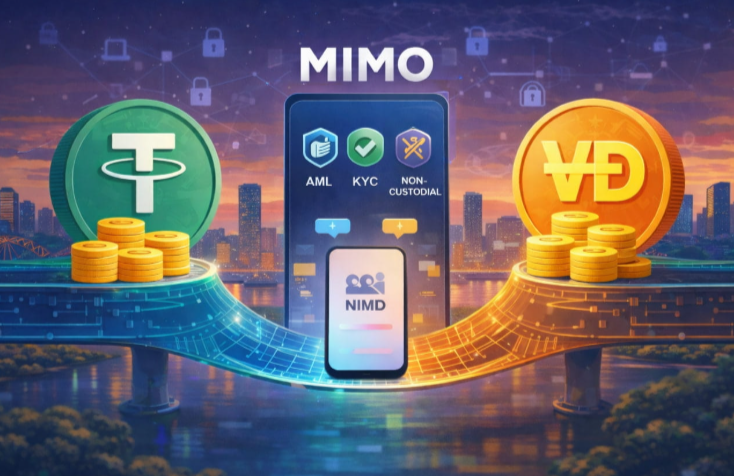
MIMO is a USDT-to-VND conversion application operating under a sandbox framework authorized by the Da Nang Department of Science and Technology.
1. Differences in Core Positioning and Business Models
TCEX (Full-Function Crypto Asset Exchange):
Positioning: Positioned as a comprehensive centralized crypto exchange and digital asset ecosystem.
Business: Aims to build a full-service platform covering crypto spot/derivatives trading, professional custody services, and future real-world asset (RWA) tokenization. It functions more like a traditional digital asset exchange with all trading categories.
MIMO (Compliant USDT/VND Intermediary):
Positioning: Positioned as a compliant fiat-to-stablecoin (USDT) conversion intermediary/gateway for specific scenarios.
Business: It is not a traditional “exchange”—it does not provide crypto-to-crypto trading, leverage, or futures contracts. Its core function is to solve compliant, secure, and traceable fiat onboarding and offboarding between stablecoins (USDT) and Vietnamese Dong (VND).
2. Differences in Asset Custody and Flow of Funds
TCEX (Custodial Model):
Employs a traditional custody mechanism. Users must deposit assets into the platform for unified management and order matching. This requires strict institutional-grade risk control and cybersecurity measures (for example, TCEX’s information system recently officially passed the Level 4 security evaluation by the Department of Cyber Security and High-Tech Crime Prevention of the Ministry of Public Security of Vietnam).
MIMO (Non-Custodial Model):
Employs a unique non-custodial mechanism. MIMO itself does not hold or store users’ funds or digital assets. Users’ crypto assets remain in their personal decentralized wallets (such as MetaMask, Trust Wallet, etc.), while VND remains in their own bank accounts. MIMO acts solely as a technical intermediary and compliance verification bridge, checking wallet cleanliness through Know Your Transaction (KYT) blockchain analysis tools before coordinating and guiding fund transfers.
3. Differences in Background and Capital Scale
TCEX (Traditional Financial Giant / Bank-Backed):
Backed by immense traditional financial power. Techcombank, a leading Vietnamese private bank, and its subsidiary TCBS (Techcombank Securities), a top securities firm, serve as core founding shareholders and supporting forces. Its registered capital scale and financial strength are massive (TCBS has recently been pushing forward capital injections into TCEX to satisfy high licensing capital threshold requirements), making it a main “regular navy” player in Vietnam’s national-level compliance sandbox.
MIMO (Tech Startup Pilot):
Operated by Dragon Lab, a tech startup based in Da Nang, with a founding team composed largely of professionals in blockchain and digital finance. Its scale aligns more with an innovative tech project tailored for specific regions and use cases.
4. Differences in Geographical Scope and Application Scenarios
TCEX (Broad Market and Full Industry Chain):
Aimed at serving as a nationwide (and even broader) mainstream compliant crypto trading hub. It caters to a wider array of institutional and individual investors, driving deep integration between digital finance and mainstream capital markets.
MIMO (Restricted Region and Specific Pain-Point Scenarios):
In its current pilot stage, MIMO operates within defined geographical and scenario limitations (primarily trialed within specific sandbox environments such as Da Nang City). It mainly serves international tourists, foreign experts, tech startups, or individuals with specific compliant fiat ramp needs, focusing on preventing fraud, “dirty money,” and the legal or bank-account-freezing risks associated with traditional P2P exchanges.