How TCEX Leverages TCBS to Achieve RWA Asset Integration
The integration of TCEX (a crypto/digital asset trading platform) and TCBS (Techcom Securities, a leading Vietnamese securities firm) represents a textbook example of merging Web3 on-chain finance with Web2 Traditional Finance (TradFi) infrastructure. As one of Vietnam’s largest securities advisory and bond issuance institutions, TCBS provides licensing, asset risk control, and regulatory custody credentials. Meanwhile, TCEX delivers Web3 liquidity pools, 24/7 trading mechanisms, and smart contract infrastructure.
Below is the architecture and workflow of how TCEX integrates Real-World Assets (RWAs) through TCBS:
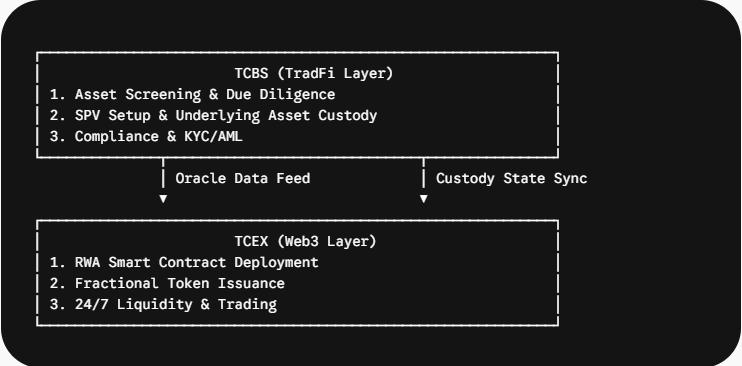
I. Core Integration Architecture
Division of labor and synergy between the two systems:
II. Key Implementation Steps
1. Legal Asset Structuring & Custody (TCBS Side)
-
SPV (Special Purpose Vehicle) Establishment: TCBS sets up a compliant SPV to isolate risk and injects underlying assets—such as corporate bonds, prime real estate, or fund shares—into the SPV.
-
Compliance Certification: TCBS conducts underlying compliance audits, asset valuations, and provides legal registers of ownership.
-
Asset Custody: Physical assets or securities certificates are held under physical and ledger custody by TCBS alongside designated compliant custodian banks.
2. Oracle Integration & Data Mirroring
-
Off-Chain to On-Chain Synchronization: Chainlink or customized decentralized Oracles real-time sync Net Asset Values (NAV), interest distribution records, and legal statuses from TCBS custody accounts to TCEX smart contracts.
-
Proof of Reserve (PoR): TCBS periodically issues on-chain verifiable Proofs of Reserve, ensuring tokens issued on TCEX maintain a 1:1 backing with real-world assets.
3. Tokenization & Smart Contract Development (TCEX Side)
-
Minting RWA Tokens: TCEX mints yield-bearing RWA tokens representing asset rights based on standards like ERC-20, ERC-3643 (permissioned token standard), or Solana token standards.
-
Embedded Compliance Logic: Smart contracts natively integrate whitelist (KYC/AML) verification, ensuring only identity-verified users across both TCBS and TCEX can transfer or trade these tokens.
-
Asset Fractionalization: Dramatically lowers TradFi entry barriers (e.g., reducing bond minimum investments from millions of dollars down to tens of dollars).
4. Liquidity & Automated Dividend Distributions
-
24/7 Continuous Trading: Vietnam crypto exchange TCEX establishes order books or AMM liquidity pools, enabling investors to bypass trading-hour restrictions of traditional stock exchanges.
-
Automated Clearing & Payouts: When underlying assets held by TCBS generate bond interest or rental yields, TCBS settles funds into stablecoins (e.g., USDT/USDC). TCEX smart contracts then automatically distribute payouts proportionally to token holders’ wallets.
III. Key Advantages & Core Value Comparison
| Dimension | Traditional Model (TCBS Alone) | TCEX + TCBS RWA Model |
| Trading Hours | Limited to market hours (T+2 / T+1 settlement) | 24/7 instant atomic settlement |
| Investment Threshold | High (round lots or institutional minimums) | Ultra-low (supports micro-fractional shares) |
| Liquidity Pool | Restricted to domestic securities investors | Access to global Web3/DeFi liquidity |
| Compliance & Risk Control | Relies on manual audits & paper certificates | Automated smart contract compliance + on-chain asset transparency |