
TCEX Platform: Comparative Table of Crypto Assets vs. Other Investment Products
Comparing crypto assets with other investment products
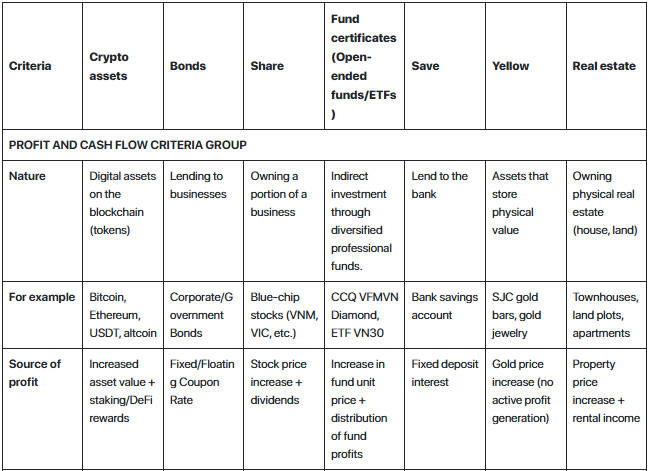
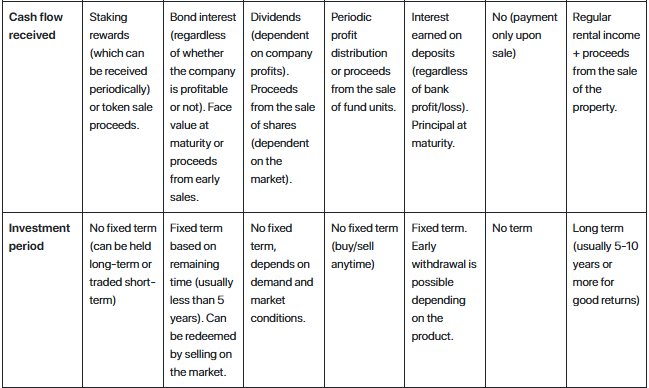
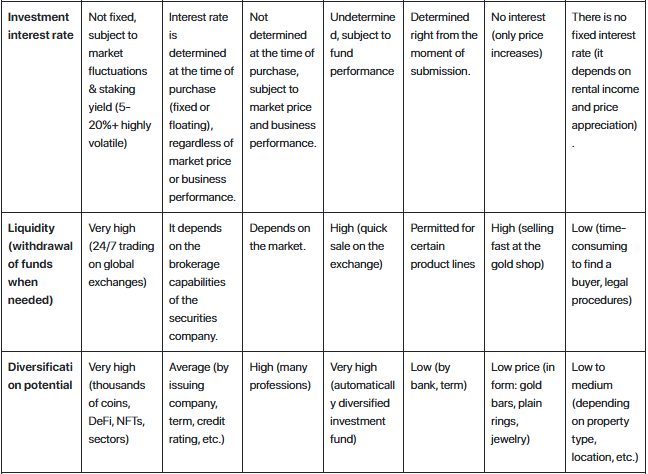
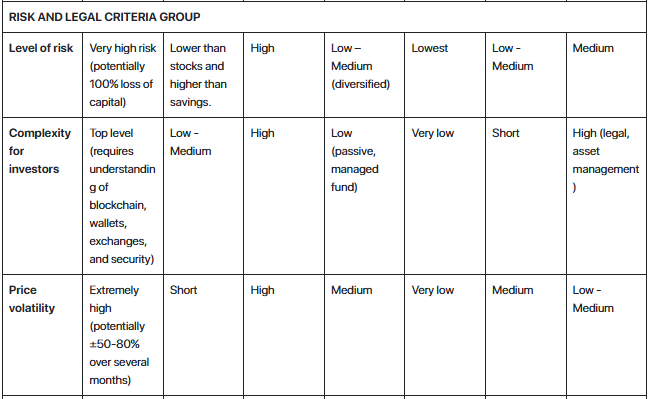
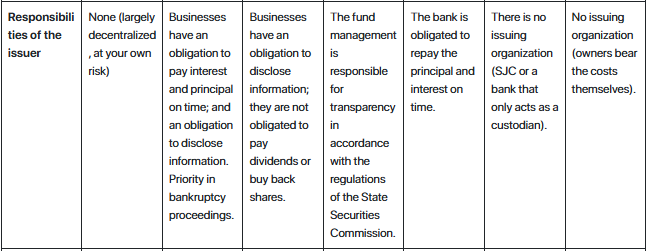
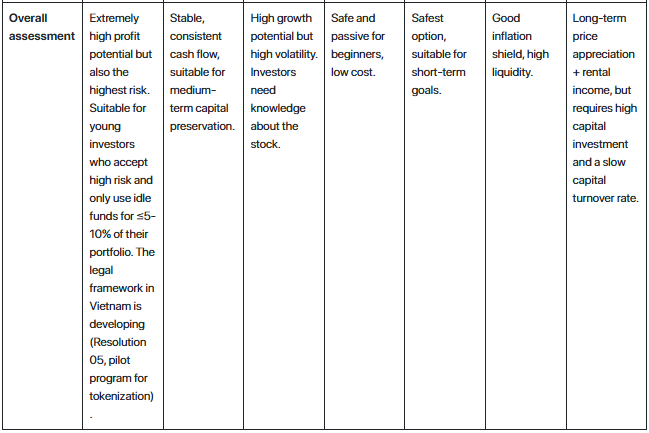
Compared to Real Estate: The biggest differences lie in capital turnover speed and entry thresholds. Real estate is a typical “capital-intensive” investment requiring substantial upfront capital (often hundreds of millions to billions of VND) and a lengthy buying/selling process (including valuation, notarization, title transfer, taxes, and fees) that can take weeks or even months. In contrast, crypto assets—due to their fractional ownership feature—allow you to start with very minimal capital (just a few hundred thousand VND). You can take profits or stop losses instantly on the exchange 24/7. While real estate liquidity often takes a long time when you urgently need funds, making you susceptible to heavy price pressures, crypto assets offer near-instant liquidity except during extreme market volatility.
Compared to Stocks and Bonds: Although both are traded on exchanges, Asset-Backed Securities (ASQ) are clearly superior in terms of trading hours and flexibility. The Vietnamese stock market (and most others worldwide) operates only during business hours (typically 9:00 AM to 3:00 PM) and closes on weekends and holidays—meaning investors can be “trapped” in trades when major news breaks outside operating hours. Asset-Backed Securities, on the other hand, trade 24/7/365 without interruption. In essence, stocks and bonds are tied to the operating performance of the issuing company or institution (depending on financial reports, interest rates, and profits). On the other hand, Asset-Backed Securities are independent stores of value that do not rely on any single company. However, their risk is also higher: daily price fluctuations of Asset-Backed Securities can equal an entire year’s volatility of a blue-chip stock, requiring investors to strictly adhere to risk management principles.
Compared to Physical Gold: Although gold is a traditional safe-haven asset, it comes with many limitations regarding storage, transportation, and liquidity. Holding large quantities of gold incurs insurance fees, safe deposit box costs, shipping expenses, and the risk of physical loss. TSMH completely solves these issues: all assets are stored in digital wallets and can be transferred quickly, conveniently, and at extremely low costs. If you manage your own private keys (inaccessible to others), TSMH provides greater convenience and enhanced personal security. In return, you need basic technical knowledge to protect against cyberattacks, password theft, and security code vulnerabilities—unlike gold, which only requires a physical safe. Additionally, TSMH carries higher risk because its value is not backed by physical commodities like gold. Furthermore, TSMH can be easily fractionated and traded internationally, which is difficult to achieve with physical gold.
Compared to Bank Deposits: Savings deposits are the safest channel (in Vietnam, deposit insurance covers up to 125 million VND per account), but yields are usually only enough to offset inflation, or even less. Investment Banking / Venture-style Crypto Investments (IB) are the exact opposite: they represent high-risk investments whose values are entirely determined by the market without guarantees from any institution. Investors choose IB because they expect explosive growth (with the potential to double their investment in a short period), but they also accept the risk of market crashes or project failure leading to total loss. This is a clear trade-off between safety with lower yields (deposits) versus high risk with higher potential returns (IB).
Compared to Fund Certificates: Fund certificates represent a form of professional trust management: experts manage the investment portfolio, you pay a management fee (typically 1–2% annually), the net asset value (NAV) is updated daily, and operations are strictly regulated under a legal framework (monitored by the State Securities Commission). Conversely, ETFs offer a fully autonomous trading model: you select assets yourself, buy and sell anytime and anywhere, and maintain 100% control. The main disadvantage is that you bear the full risk of market volatility without being able to leverage the knowledge, skills, and insights of expert fund managers. Investing in ETFs on licensed exchanges helps mitigate security risks (such as hacking or lost wallets) and technical risks, as compliant exchanges operate with robust risk management processes and security standards as a buffer.