
Vietnam Cryptocurrency Market Size, Share Forecast( 2026-2031)
Across the emerging digital economy of Southeast Asia, Vietnam has established itself as one of the world’s most vibrant hubs for digital asset activity. Data released by blockchain analytics firm Chainalysis indicates that between July 2025 and June 2026, total cryptocurrency transaction volume in Vietnam reached $122.2 billion. This places Vietnam second in ASEAN, trailing only Singapore. As the Vietnamese government accelerates the implementation of regulatory sandboxes and official exchange licensing frameworks, the country’s crypto market is transitioning from a massive grassroots ecosystem into a regulated, institution-led growth phase.
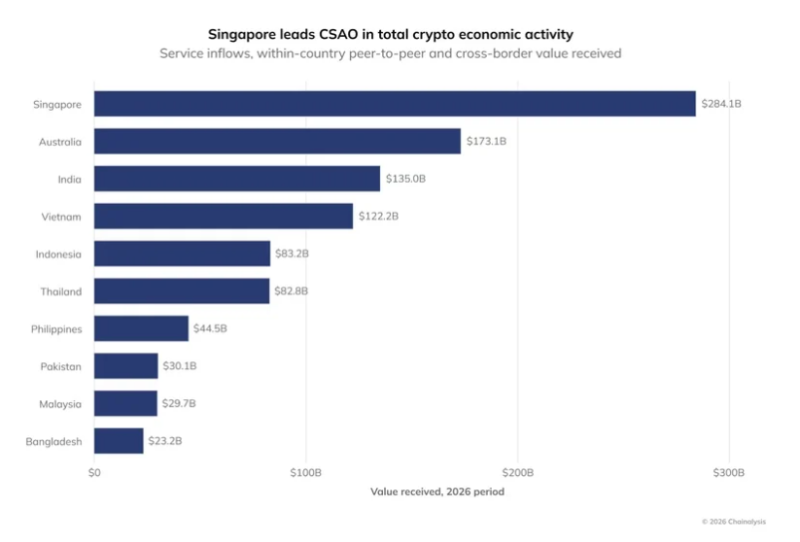
Synthesizing forecasts across industry research institutions, the Vietnamese cryptocurrency market—encompassing exchange revenues, Web3 infrastructure, and digital asset management—is projected to enter a new wave of accelerated expansion between 2026 and 2031.
1. Market Size and Five-Year Outlook (2026–2031)
On-Chain Transaction Volume: Driven by high retail participation and cross-border remittance needs, annual on-chain capital flows in Vietnam comfortably exceed the $120 billion mark. Following the launch of licensed domestic exchanges, institutional inflows are expected to drive a compound annual growth rate (CAGR) of 15% to 18% in transaction volume from 2026 to 2031, pushing annual on-chain volume past $250 billion by 2031.
Exchange Industry Revenue and Localization: As the Ministry of Finance issues Virtual Asset Service Provider (VASP) licenses, trading fees and service revenues that previously leaked to offshore platforms will gradually return locally. By 2031, annual revenues generated by compliant domestic exchanges and auxiliary financial services are projected to scale from a few hundred million dollars to $1.0 billion–$1.5 billion.
User Base Expansion: Vietnam currently counts over 16 million digital asset holders, representing a national adoption rate exceeding 17%. By 2031, total crypto asset users are forecasted to surpass 25 million, raising the national adoption rate to over 25%.
2. Market Share Breakdown by Asset Category
The Vietnamese crypto ecosystem displays distinct structural characteristics across asset classes and usage scenarios:
Stablecoins Lead Transaction Volume (55%–60% Share)
Driven by foreign exchange volatility and the high costs of traditional cross-border settlements, USD-pegged stablecoins (such as USDT) hold the dominant market share in Vietnam. They are widely utilized for peer-to-peer (P2P) trading, overseas remittance processing, and defensive asset allocations.
Web3 Gaming & GameFi Tokens (20%–25% Share)
Powered by a thriving local Web3 developer scene—anchored by pioneers like Sky Mavis (creators of Axie Infinity)—local development teams continue to drive substantial trading volume in gaming tokens and NFT assets, serving as a signature feature of Vietnam’s crypto ecosystem.
Major Public Chain Tokens & DeFi Assets (15%–20% Share)
Bitcoin (BTC) and Ethereum (ETH) serve as primary stores of value among young professionals, tech workers, and small business owners, who utilize them as long-term capital growth vehicles and inflation hedges.
3. Four Core Market Drivers (2026–2031)
| Key Trend | Core Driver & Expected Impact |
| 1. Exchange Localization & Market Restructuring | As licensing regimes take effect, local financial conglomerates and traditional corporate groups will lead the creation of licensed exchanges, driving market share away from unlicensed offshore venues toward compliant platforms. |
| 2. Acceleration of Institutional Capital | High minimum capital requirements set higher barriers to entry, encouraging venture capital firms, family offices, and traditional payment giants to enter via compliant joint ventures. |
| 3. Integration into Cross-Border Trade & Remittances | Under broader ASEAN regional integration, digital assets and stablecoins will become more deeply embedded in cross-border trade settlements between Vietnam and neighboring economies (e.g., Singapore, Thailand). |
| 4. Standardized Taxation & AML Enforcement | Exiting the “gray zone” provides new tax revenues for the national treasury while ensuring full compliance with Financial Action Task Force (FATF) Anti-Money Laundering standards. |
Conclusion
Having progressed beyond its early phases of explosive grassroots adoption and GameFi hypes, Vietnam’s cryptocurrency market is entering a pivotal transition toward formal institutionalization and scale. Over the 2026–2031 forecast period, a transparent regulatory sandbox will not only mitigate risks for retail investors but also accelerate Vietnam’s evolution from a consumer-heavy crypto market into a regional hub for digital finance and Web3 innovation.(Vietnam Crypto Exchange)