
CAEX Vietnam apppoints former Binance leader as senior advisor
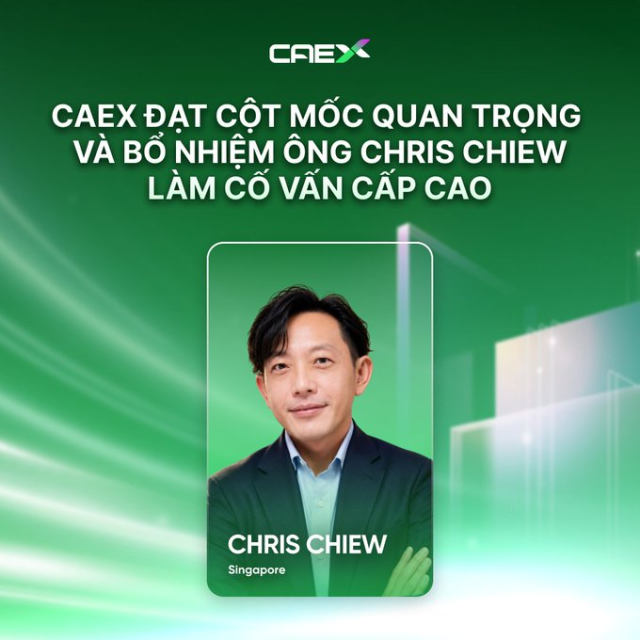
CAEX has officially appointed Mr. Chris Chiew, former Global Director of Spot Trading and Custody at Binance, to the position of Senior Advisor, directly joining the strategic executive team.
At the same time, CAEX has also completed the preliminary approval phase from the Ministry of Finance in the roadmap to obtain an operating license for a cryptocurrency exchange in Vietnam, continuing to pursue a transparent and legally compliant model
On May 12th upcoming, Mr. Chris Chiew will represent CAEX to attend Digital Trust in Finance 2026 — a national forum bringing together financial institutions, technology companies, and regulatory agencies to discuss the future of digital assets.(Vietnam Crypto Exchange)
Vietnam’s developing cryptocurrency market
Mr. Chris Chiew has experience combining the traditional financial sector and the global digital asset infrastructure. Before joining CAEX, he oversaw global spot trading and digital asset custody at Binance.
Before that, he had worked for more than 12 years at Goldman Sachs, in major financial centers such as Singapore, Tokyo and Beijing.
This combination has important strategic significance. As Vietnam aims for a tightly regulated cryptocurrency legal framework, exchanges are increasingly looking for executives who are able to grasp both institutional financial standards and cryptocurrency-based operating models.
In this environment, experience in regulatory compliance, custody and market infrastructure becomes a competitive advantage rather than merely a management degree.
CAEX Moves Closer To Legality From Organizations
This appointment also signals CAEX’s broader ambition to position itself as a tightly regulated platform, suitable for institutions, rather than just a trading platform focused on individual investors.
On May 12, Mr. Chris Chiew is expected to represent CAEX at the Digital Confidence Forum in Finance 2026, a forum supported by the Ministry of Public Security of Vietnam and coordinated with the Ministry of Finance and the State Bank of Vietnam.
The meaning of this participation lies in signaling, not just in presence. In the emerging legal environment, the proximity to policy discussions often reflects which companies are being valued in the ecosystem of organizations.
Capital mobilization in accordance with Vietnam’s legal requirements
CAEX has also strengthened its financial position before the licensing process. The company has recently received strategic investment from OKX Ventures and HashKey Capital, raising charter capital to about 10 trillion VND.
This moment is remarkable because Vietnam’s pilot legal framework for digital asset exchanges is expected to require significant financial capacity and operational protection measures from participating platforms.
By raising strong capital before approval, CAEX seems to be positioning itself not only as a candidate, but also as a platform capable of meeting compliance standards and infrastructure at the organizational scale.
The licensing race in Vietnam begins to take shape
This company is said to be one of the few platforms that has passed the first profile review stage in the growing exchange licensing process in Vietnam. Other companies have entered the initial approval stages including platforms such as TCEX and SCEX, showing that the domestic exchange race is beginning to focus on a small group of serious institutional competitors.
This marks a major change for Vietnam’s cryptocurrency industry. For many years, the market operated mainly through foreign exchanges and unofficial participation. The emergence of a managed licensing process that provides capital requirements, operational supervision and legal liability brings the sector closer to the traditional financial market structure.
Evaluation and conclusion
CAEX’s appointment of Chris Chiew is not merely a high-level personnel change. It reflects a broader transition unfolding in Vietnam’s digital asset sector, where exchanges are evolving from startup-like platforms into competitive institutions for legal recognition and a long-term market infrastructure role.
And as the licensing race accelerates, the companies most likely to succeed may not be the ones with the strongest voice in the market but the ones most capable of adjusting innovation in the cryptocurrency sector to match the standards of traditional finance and state oversight.